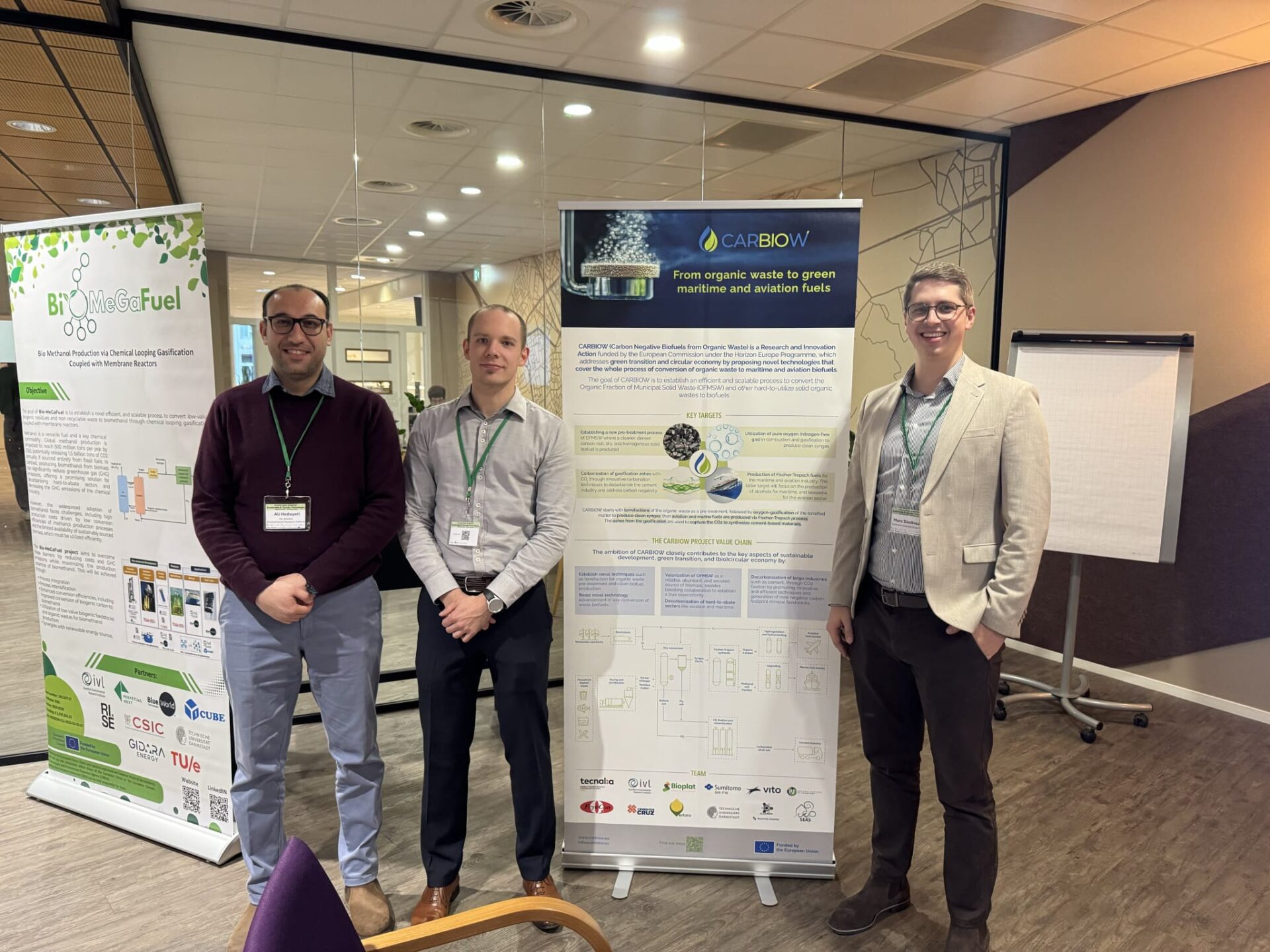
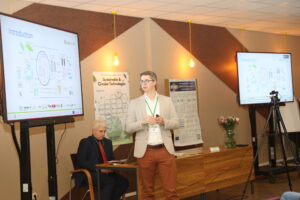
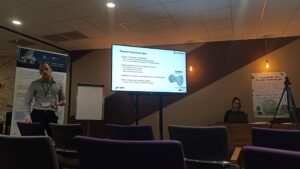
The CARBIOW project took part in the International Workshop on Sustainable and Circular Technologies, held in Eindhoven (The Netherlands) from 26 to 27 November, sharing insights from three project partners working at the forefront of advanced biofuels, biomass conversion and circular-material solutions. Over two days, the workshop brought together representatives from thirteen European initiatives, creating a rich environment for knowledge exchange, collaboration and forward-looking discussion on the future of sustainable technologies.
The workshop brought together 13 EU-funded projects driving innovation in circular systems – focused on sustainable fuels, carbon recycling, circular value chains, and next-generation electrochemical processes -, a collaborative platform for researchers, technologists, policy-makers, and industry players and cross-project collaboration.
CARBIOW contributed to the organisation of the workshop and actively participated in the programme through four partner presentations.
Steering Advanced Biofuels Through Collaboration – IVL’s Perspective
On 26 November, Ali Hedayati, CARBIOW’s Technical Coordinator and Project Manager at IVL Swedish Environmental Research Institute, joined a dynamic panel on advanced biofuels and biomass conversion. The discussion centred on the strategic role of next-generation biofuels in Europe’s transition towards a circular, low-carbon energy system and the obstacles that research projects still face in bringing breakthrough technologies to market. Hedayati emphasised that in highly complex initiatives such as CARBIOW, strong partnerships are essential.
Continuous communication across the consortium, he noted, has been vital in navigating the technical challenges inherent to cutting-edge R&D, especially in advanced conversion routes like Fischer–Tropsch synthesis.
Not every experiment yields the expected outcome, but the panel agreed that even setbacks generate valuable knowledge: With the right adjustments, today’s complication can become tomorrow’s breakthrough.
Partners from related EU-funded projects, including DESIRED, Bio-FlexCLC project and Bio-MeGaFuel Project, echoed a shared priority—making advanced biofuels more sustainable. Reliable access to local biomass remains a challenge across Europe, and achieving CO₂-negative performance standed out as the sector’s most ambitious goal.
Boosting Syngas for Next-Generation Fuels – TU Darmstadt’s Experimental Breakthroughs
Also on site was Marc Siodlaczek, Research Assistant at Technische Universität Darmstadt, who contributed to the session on renewable fuels and products with new findings from CARBIOW’s work on fluidised-bed oxygen–steam gasification of torrefied biogenic residues.
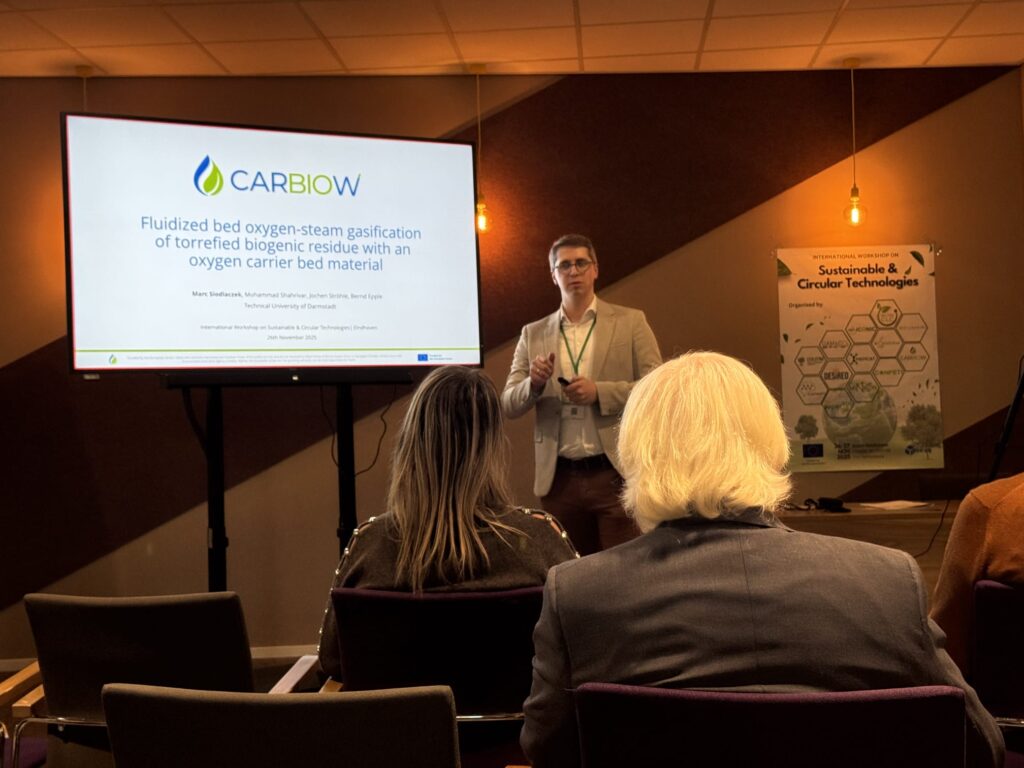
His presentation outlined how oxygen-carrier bed materials can significantly enhance process efficiency and improve syngas quality—an essential step for producing high-value renewable fuels suited to hard-to-electrify sectors such as aviation and maritime transport. He highlighted that different biogenic residues behave very differently inside the reactor, making feedstock selection and pre-treatment crucial to performance. The process has now been demonstrated at pilot scale using wood, marking an important technical milestone, while areas such as ash handling still require optimisation to ensure stable and continuous operation.
The experiments conducted within CARBIOW are generating data that closely mirror industrial conditions, laying a robust foundation for future scale-up activities.
Turning Waste Into Climate-Positive Cement Materials – TECNALIA’s Circular Approach
Later on 26 November, Asier Oleaga, research technician at TECNALIA, presented CARBIOW’s approach to converting oxy-fired fluidised-bed waste streams into valuable, low-carbon materials for the cement sector.
He showcased how alkaline residues—including bottom ash and LD slag—can undergo accelerated mineralisation, capturing significant amounts of CO₂ while forming new mineral phases suitable as supplementary cementitious materials. This approach transforms industrial by-products into resources that support lower-footprint cement formulations.
Oleaga also underlined the project’s advances in digital monitoring: by integrating spectral techniques with machine-learning models, CARBIOW can track carbonation levels in real time and optimise CO₂ fixation throughout the process. This capability is vital for scaling mineralisation technologies and ensuring consistent product quality, reinforcing their role in circular, climate-positive industrial value chains.
Reimagining Catalysts with 3D Printing – VITO’s Leap in Fischer–Tropsch Innovation
The CARBIOW project concluded its participation on 27 November with a presentation by Dr Yoran De Vos, Research Scientist at VITO, within the session on systems analysis and emerging challenges. De Vos introduced pioneering work on 3D printing and the preparation of catalyst monoliths for Fischer–Tropsch synthesis, illustrating how additive manufacturing can unlock new design possibilities for catalytic structures.
His team explored every aspect of the process—from printing methods and rheology to binder choice, heat treatments and impregnation strategies—resulting in a leap in geometric surface area from 2,000–3,000 m²/m³ to nearly 10,000 m²/m³. More than 150 monoliths have now been produced, with scaled reactor tests underway.
De Vos also highlighted the potential for future collaborations to advance the technology further, underlining how innovation in catalyst design contributes to the wider sustainable-energy transition.
The CARBIOW project ’s presence at the workshop demonstrated the value of bringing together diverse expertise to accelerate progress across the bioenergy and circular-materials landscape. Special thanks go to 1 Cube BV for organising an excellently curated event that fostered collaboration, knowledge exchange and meaningful opportunities for cross-project engagement.
🔗 Access the workshop booklet here
🔗 Photos and videos available here