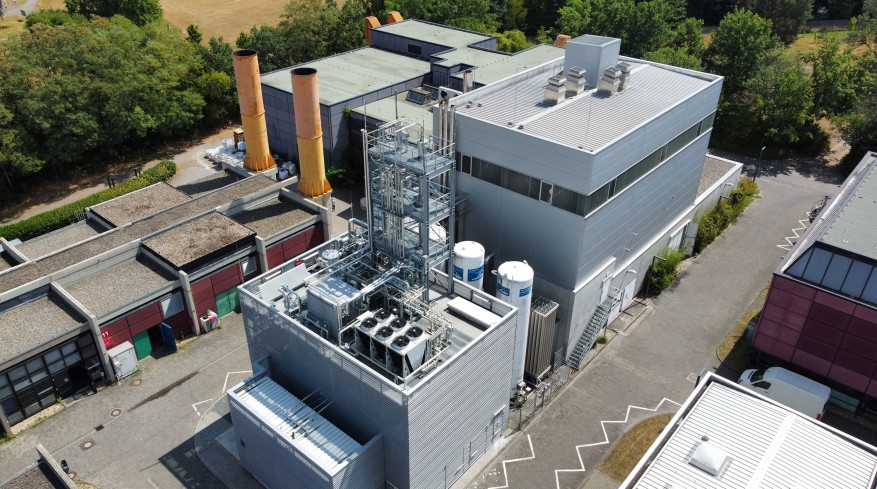
Photo credit: Die CARBIOW-Versuchsanlage auf dem Campus Lichtwiese. Bild: EST/Christof Bon
The Technische Universität Darmstadt (TUDa) has recently achieved an important milestone by successfully demonstrating key parts of the process during a multi-day test campaign. The gasification of new feedstocks was carried out at an industrially relevant scale in a pilot plant at the Institute for Energy Systems and Technology (EST).
The goal of CARBIOW is to process organic waste streams that are difficult to recycle—such as organic municipal waste and agricultural residues like maize cobs—so they can serve as feedstock for the production of aviation and marine fuels. The material is first torrefied, meaning it is dried at around 250°C to increase energy density and improve transportability. The process then continues with conversion into synthesis gas, mainly composed of hydrogen and carbon monoxide. Through subsequent Fischer–Tropsch synthesis, this syngas can be used to produce sustainable aviation fuel (SAF) and alcohol-based marine fuels such as methanol.
As part of the project, innovative technologies were assessed across the entire value chain. EST, led by Professor Bernd Epple in the Department of Mechanical Engineering at TU Darmstadt, was responsible for gasification and gas processing. Its near-industrial-scale pilot plant makes it possible to realistically test and scale technologies. Approximately seven tonnes of wood pellets and nine tonnes of torrefied maize cob residues were processed during the campaign.
Gasification was performed in a circulating fluidised bed. In this process, the fine-grained bed material is intensively mixed with hot gases. While sand is typically used as bed material, CARBIOW employed an iron–titanium ore for the first time at EST. This ore enhances oxygen transfer and provides catalytic properties that support higher conversion rates. The tests confirmed the high efficiency of the process and identified optimisation opportunities for the treatment of new waste residues.
The pilot plant at TU Darmstadt enables realistic evaluation of the technology across the full production chain. The results will feed into economic and environmental assessments that will support future investment decisions. CARBIOW aims to contribute to the decarbonisation of transport sectors that are difficult or impossible to electrify, such as aviation and maritime shipping.
Read the original article (TU Darmstadt): https://www.tu-darmstadt.de/universitaet/aktuelles_meldungen/einzelansicht_542272.de.jsp
Media coverage:
The article has also been featured in several external media outlets:
• German Aerospace Society (DGLR): https://www.dglr.de/nc/informieren/meldungen/newsmeldung-einzel/article/tu-darmstadt-testet-verfahren-zur-produktion-nachhaltiger-kraftstoffe/
• AeroTelegraph: https://www.aerotelegraph.com/ticker/tu-darmstadt-testet-verfahren-zur-produktion-nachhaltiger-kraftstoffe-auch-fuer-die/v53ex8q
• Airliners.de: https://www.airliners.de/tu-darmstadt-testet-saf-herstellung-bioabfaellen/85413