By Dr. Svetlana Obydenkova
Researcher, Faculty of Science and Engineering, AMIBM – Sust. of Chemicals & Material Aachen-Maastricht Institute for Biobased Materials
In the CARBIOW project, Maastricht University is conducting a sustainability assessment of a novel value chain that converts food waste into aviation and maritime fuels. Decarbonizing these transport sectors remains one of the major challenges, as they are hard to electrify and rely on energy-dense fuels compatible with existing engines. Sustainable biomass can contribute to such fuels, but its availability is limited, highlighting the need for additional, non-competing resources.
One such option is the organic fraction of municipal solid waste (kitchen waste), a currently under-used feedstock. Although heterogeneous, it offers a valuable local resource for advanced conversion routes without competing with conventional biomass supplies.
The CARBIOW value chain
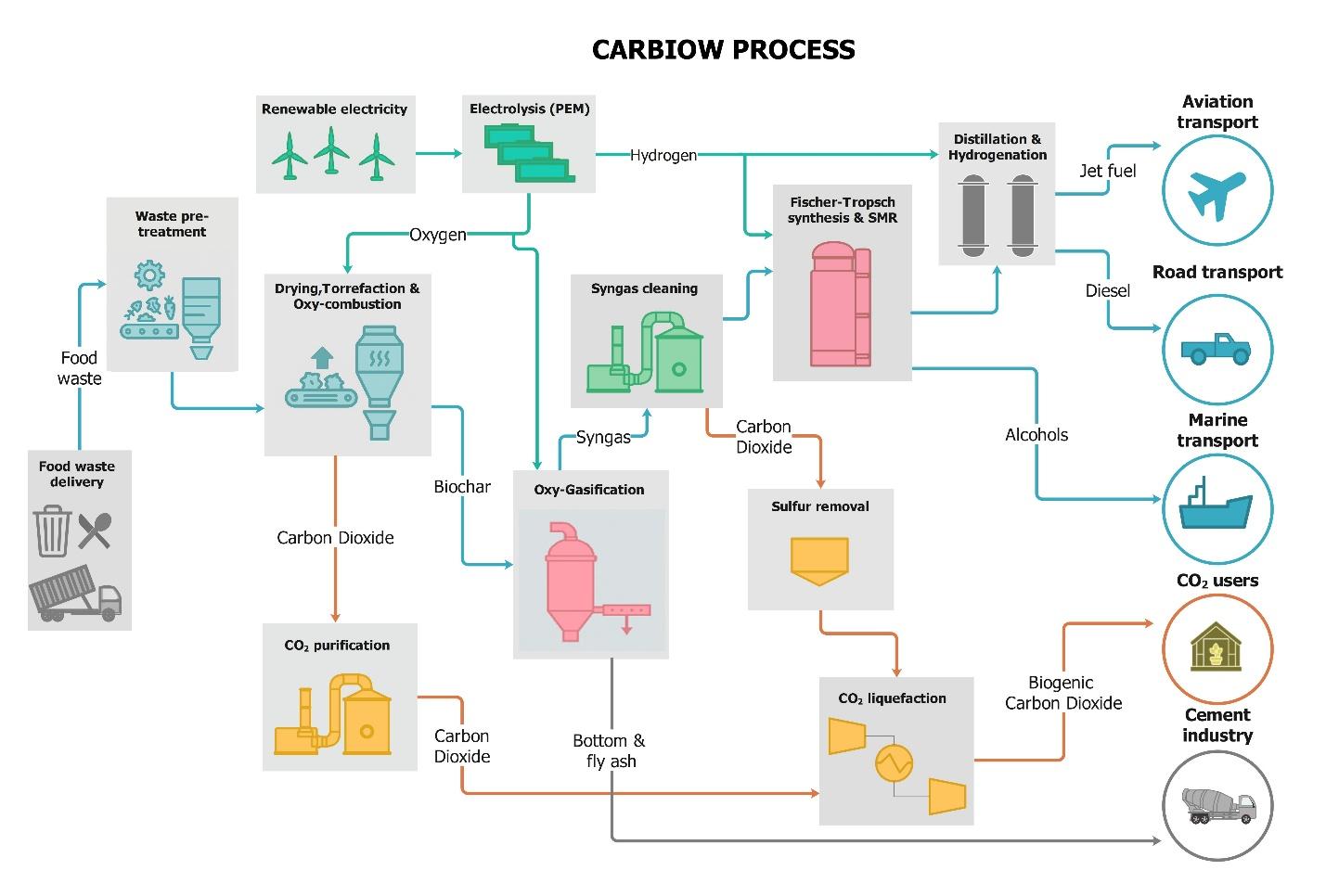
The CARBIOW project explores a new value chain in which food waste is converted into transport fuels via thermochemical processing. First, the waste is torrefied to produce a homogeneous, carbon-rich biochar. This char is then gasified with pure oxygen, and the resulting syngas is cleaned and upgraded before entering Fischer–Tropsch synthesis to produce jet fuel, alcohols and low-sulfur diesel fractions.
Throughout the process, extensive gas cleaning enables the recovery of high-purity biogenic CO₂, which is captured, liquefied and sold as a marketable co-product.
Regional waste availability and logistics constraints
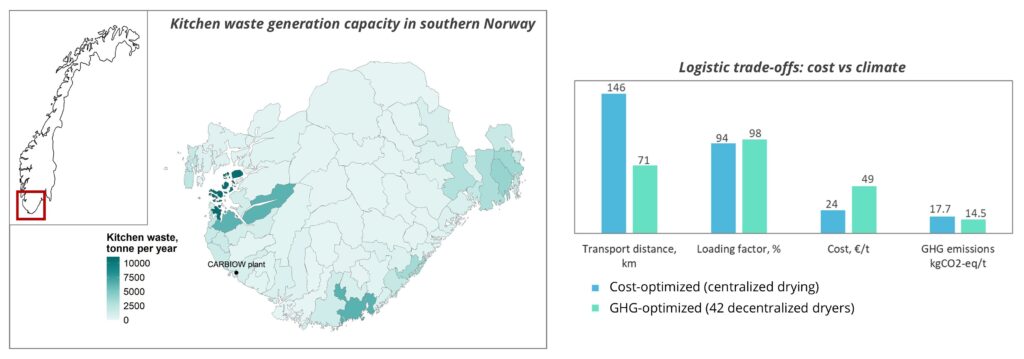
The project first assessed kitchen-waste volumes from three municipalities near the future Eigersund Business Park, but these proved too small to benefit from economies of scale. The study area was therefore expanded to 71 municipalities across Rogaland, Telemark, Agder and Vestfold. This regional waste capacity corresponds to a scale similar to that used in the pilot tests carried out by the CARBIOW partner Technische Universität Darmstadt.
A key challenge is the uneven geographical distribution of waste, combined with strict pick-up frequency regulations that force trucks to operate even when not fully loaded. To address this, we developed an optimisation model exploring strategies such as consolidating waste flows, using multiple truck sizes, and applying decentralised drying at source.
Commercial small-scale electrical dryers for local (decentralised) drying can reduce moisture to 6–8 wt % and extend storage, but their high CAPEX and electricity costs limit their economic viability, creating a trade-off between transport cost and GHG emissions.
The analysis also shows that small-capacity refuse trucks play an important role in reducing both transport costs and emissions in the region.
How much fuel could CARBIOW deliver?
Based on the current design and capacity, the amount of kitchen waste available in the four counties of southern Norway could enable CARBIOW to produce sustainable aviation fuel (SAF) equivalent to roughly 3.6 % of the domestic aviation fuel demand associated with the population of this region, assuming the Norwegian average per-capita flight activity
Current practices and climate challenges
We also assessed current food-waste management in the region. Today, about 78 % of kitchen waste goes to anaerobic digestion and 22 % to composting. These routes provide societal benefits by avoiding landfilling, generating renewable energy, and recycling nutrients. Yet these systems still face climate challenges.
Anaerobic digestion is capital-intensive and remains the main contributor to the carbon footprint of biomethane, largely due to fugitive methane emissions – a major climate concern, as methane has a global warming potential 27 times that of fossil CO₂ (IPCC AR6). Recent LCA studies identify methane slip as the dominant driver of impacts in biogas systems.
Composting, while simpler, typically results in nitrous oxide (N₂O) emissions from microbial nitrogen transformations. However, N₂O has an even higher global warming potential of 273 (IPCC AR6).
Carbon utilisation in the CARBIOW concept
The CARBIOW design maximizes carbon retention in valuable products. By using oxygen – the by-product of water electrolysis – in both oxygen-blown gasification and oxy-combustion of torgas, the process avoids nitrogen dilution and enables a highly efficient conversion of carbon into fuels. Advanced gas-cleaning technologies play a critical role: they allow the recovery of a nearly pure biogenic CO₂ stream and limit carbon losses to minor flaring.
In addition, the purified biogenic CO₂ stream can be provided to other users, such as greenhouse horticulture, replacing the fossil-derived CO₂ currently used to enhance crop growth.
Next steps
Preliminary modelling suggests that the CARBIOW pathway can achieve a carbon footprint comparable to advanced biomethane technologies, while delivering greater societal value by producing energy-dense fuels and purified biogenic CO₂. We are now in the final stage of model refinement and process assessment.